
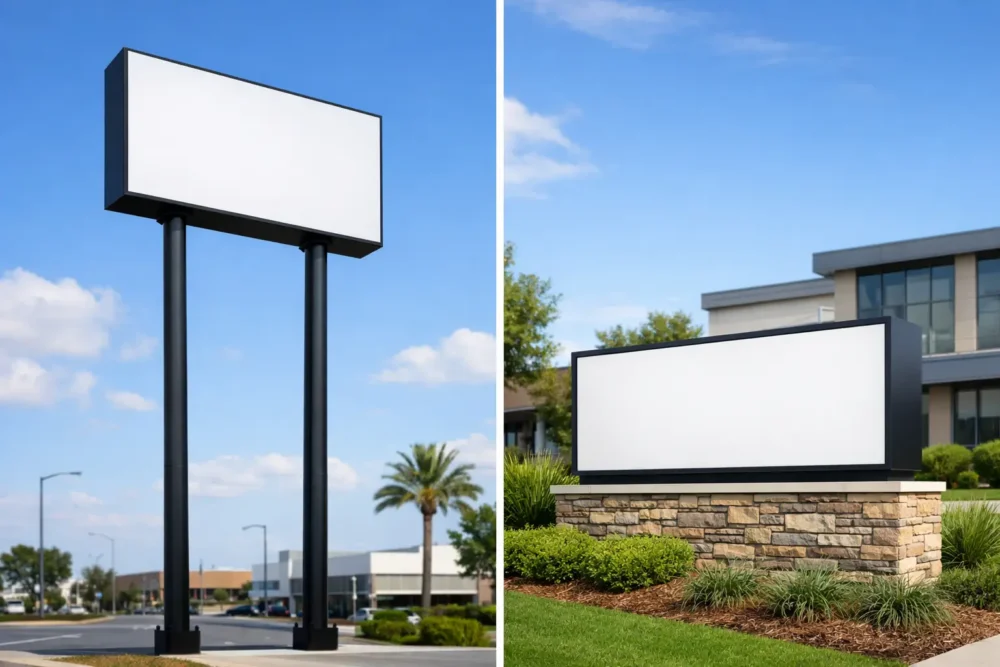
A sign can be beautifully made and still fail at its main job: getting people to your door. When comparing pylon signs versus monument signs, the right choice comes down to where customers first see your property, how fast they are traveling, and what kind of impression your business needs to make before they park.
For a retail center on a busy Queens corridor, visibility from several lanes of traffic may call for height. For a medical office, school, church, or professional building, a lower sign with a permanent, polished presence may do more for the brand. The sign format is not just a design preference. It affects visibility, site planning, permitting, construction, and long-term value.
What Is a Pylon Sign?
A pylon sign is a freestanding sign mounted high above the ground on one or more structural poles. You will often see them along major roads, at shopping centers, gas stations, auto dealerships, and commercial properties with multiple tenants. Their height is their advantage.
A well-designed pylon sign can be visible from a significant distance, especially where drivers need time to identify a business, change lanes, and turn safely. It can feature a single business name or a multi-tenant cabinet with individual panels for each occupant. Illuminated faces, channel letters, digital message components, and changeable tenant panels can all be incorporated depending on the project and local regulations.
Pylon signs are built for reach. If your storefront sits behind a parking lot, off a service road, or within a crowded commercial strip, the added elevation can keep your brand from getting lost among traffic lights, utility poles, trees, and competing storefronts.
What Is a Monument Sign?
A monument sign is a low-profile freestanding sign that is typically built close to the ground. Instead of standing on exposed poles, it has a broad base that may use masonry, aluminum, stone veneer, stucco, metal, or other materials designed to complement the building and landscape.
Monument signs are common at office complexes, apartment communities, schools, healthcare facilities, places of worship, banks, and higher-end retail properties. They can hold dimensional letters, illuminated lettering, routed panels, tenant listings, or electronic message centers where permitted.
The purpose is different from a pylon sign. A monument sign does not try to dominate the skyline. It creates a strong arrival point and makes a property feel established, organized, and intentional. For businesses where trust, professionalism, and curb appeal matter as much as raw visibility, that distinction carries real weight.
Pylon Signs Versus Monument Signs: The Core Difference
The biggest difference is viewing distance. A pylon sign is designed to be seen from far away and often at driving speed. A monument sign is designed to be seen as people approach, enter, or pass directly in front of a property.
That makes pylon signs a strong option for properties near high-traffic roads, intersections, highways, and large commercial corridors. A restaurant set back from the street, for example, may need elevated identification to capture drivers before they pass the entrance. A multi-tenant plaza may also benefit from a pylon sign because it gives every tenant a visible place on the property.
Monument signs work best when the property itself is part of the brand experience. A dentist’s office, law firm, college, residential development, or private school may not need to be seen from a half-mile away. It needs to look credible, welcoming, and easy to find at the point of arrival. A monument sign accomplishes that without overwhelming the architecture.
Neither format automatically produces better results. The winning sign is the one that solves the visibility problem on your specific site.
When a Pylon Sign Makes Business Sense
Choose a pylon sign when elevation is necessary to overcome distance or visual clutter. The more decisions a driver must make before reaching your entrance, the more valuable early visibility becomes.
A pylon sign can be especially effective when your business is in a shopping center with a large setback, when your storefront is partially hidden, or when multiple tenants need equal exposure. It is also a practical investment for franchises and businesses whose customers are likely to make quick, unplanned stops. If someone can identify your logo in time to turn in, your sign is doing more than displaying a name. It is creating a sales opportunity.
There are trade-offs. Taller signs generally require more structural engineering, deeper foundations, electrical planning, and careful permitting review. They can cost more than a simple monument sign, particularly when illumination, tenant panels, or custom fabricated elements are involved. Local sign codes may also limit height, area, placement, or digital display features.
When a Monument Sign Is the Better Move
Choose a monument sign when the goal is to strengthen the character of the property while giving visitors clear, close-range identification. It is often the better fit for organizations that want a substantial presence without a towering structure.
The design flexibility is a major benefit. A monument sign can match the brick of an apartment building, the clean aluminum details of a medical office, or the architectural finishes of a school campus. Landscaping around the base can make the sign feel like a natural part of the site rather than an add-on.
Monument signs can also be easier to integrate into properties with lower building heights, neighborhood-sensitive design requirements, or limited sightline needs. However, lower does not mean simpler in every case. Custom masonry, stone finishes, illuminated letters, and site work can add cost. The sign must also be positioned carefully so parked cars, shrubs, snow piles, or street furniture do not block it.
Visibility Is More Than Sign Height
Business owners often start with one question: “How tall can we make it?” That is understandable, but height alone does not guarantee performance. The best sign program considers the full approach to your property.
Start with the direction traffic comes from, average vehicle speed, distance to the entrance, competing signs, street trees, building setbacks, and whether customers arrive by car or on foot. A tall pylon sign facing the wrong direction will not solve a visibility issue. Likewise, a monument sign with high-contrast lettering and strategic placement can outperform a larger sign that is poorly positioned.
Letter size matters, too. Drivers need to read a sign quickly. That means simplifying the message, prioritizing the business name or logo, and avoiding a crowded layout. For multi-tenant properties, the sign should establish a clear hierarchy so the primary tenants and wayfinding information remain readable.
Budget, Permits, and Installation Planning
Your budget should account for more than the sign face. Freestanding signs involve design, fabrication, foundations, engineering when required, electrical connections for illumination, municipal approvals, installation equipment, and potential site restoration.
In New York City and surrounding areas, site conditions can be demanding. Underground utilities, sidewalk clearances, landlord requirements, zoning restrictions, and local permitting rules can all shape the final solution. This is why the planning stage matters. Choosing a sign type before reviewing the property can lead to delays, redesigns, or a concept that cannot be approved as proposed.
A full-service sign partner can assess the site, recommend an appropriate format, develop a design that supports your brand, fabricate the sign, and manage installation. That eliminates the usual handoff problems between designers, fabricators, electricians, and installers.
The Best Choice May Be Both
Some properties should not treat this as an either-or decision. A pylon sign can handle long-distance identification from the road, while monument signage at the entrance creates a stronger arrival experience. The two formats can work together when the site is large, multi-tenant, or approached from several directions.
For example, a retail plaza may use a pylon sign for tenant visibility from the main road and a monument sign near the driveway to reinforce the property name and direct visitors. A healthcare campus may use a monument sign at the entrance plus smaller wayfinding signs throughout the property. Each sign has a specific job, and the system performs better than one oversized sign trying to do everything.
Before committing to a format, look at your site the way a first-time customer does: from the road, from the turn lane, at the entrance, and in the parking lot. Then build the sign solution around the moment your customer needs direction most. 10X Sign Company can help turn that site review into a sign plan that gets your business noticed and gets visitors where they need to go.