
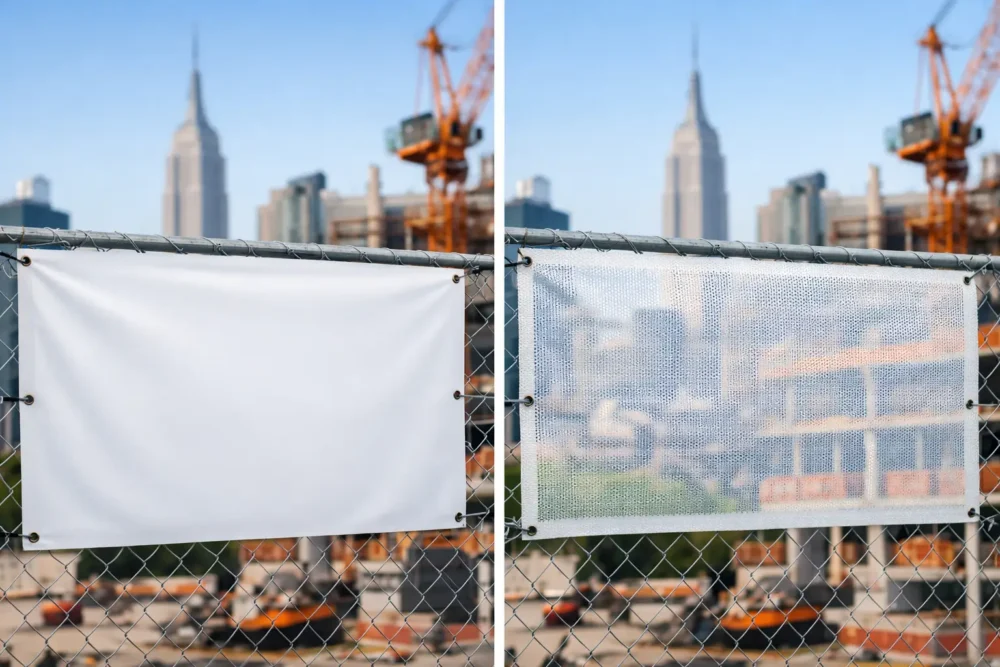
A banner can do more than announce a sale or display a logo. It can pull attention from traffic, define a construction site, promote an event, or make a storefront impossible to miss. When comparing vinyl banners vs mesh banners, the right choice comes down to one practical question: will your banner need to fight the wind, or does it need to deliver the strongest possible visual impact?
For NYC businesses, property managers, event organizers, and contractors, that distinction matters. A banner that looks great in a calm indoor setting may strain, tear, or become a safety concern on an exposed fence, rooftop, or busy street corner. The material has to match the location, the installation method, and the job it needs to do.
Vinyl Banners vs Mesh Banners: The Core Difference
Standard vinyl banner material is a solid, non-perforated surface. It creates a smooth print area with saturated colors, sharp lettering, and high-impact graphics. Because light and wind cannot pass through it, vinyl is usually the first choice when visual quality is the top priority.
Mesh banner material has tiny perforations across its surface. From a distance, the printed image still reads clearly, but the holes allow air to pass through. That reduces wind resistance significantly, making mesh a smarter material for large outdoor installations in exposed areas.
Neither option is automatically better. Vinyl wins when you need bold presentation. Mesh wins when wind load could compromise the banner, its hardware, or the structure holding it in place.
When a Vinyl Banner Is the Best Move
Vinyl banners are built for visibility. If your message needs to be read clearly from a sidewalk, parking lot, interior lobby, or passing vehicle, solid vinyl gives you the strongest possible canvas. Colors appear fuller, fine type is more legible, and photo-based artwork has more depth than it typically does on perforated material.
This makes vinyl a strong choice for storefront promotions, restaurant specials, grand openings, school events, trade show displays, church programs, indoor directional banners, and temporary retail campaigns. It is also highly effective on short-term outdoor installations where wind exposure is limited or the banner is securely mounted to a solid surface.
A vinyl banner can be finished with hemmed edges, reinforced corners, grommets, pole pockets, or other mounting options based on the installation. Those details are not cosmetic. Proper finishing helps distribute tension and gives the banner a cleaner, longer-lasting presentation.
The trade-off with solid vinyl
The same solid surface that makes vinyl so visually powerful also catches wind. On a large banner installed across an open fence, scaffold, building facade, or outdoor frame, wind pressure can create substantial force. That force can stretch the material, pull grommets, damage mounting hardware, or cause a banner to billow loudly and look unprofessional.
For a small banner on a protected storefront wall, this may not be a concern. For a large banner facing an open avenue, waterfront, rooftop, or construction site, it can be the deciding factor. Choosing vinyl for a windy location without the right hardware and installation plan is a shortcut that can become an expensive replacement job.
When Mesh Banners Deliver Better Results
Mesh banners are designed for wind-prone environments. Their perforated structure lets air move through the material instead of pushing against a solid wall of vinyl. This lower wind load makes them especially useful for construction fences, chain-link fences, scaffolding, building wraps, outdoor event perimeters, athletic fields, and large exterior installations.
In Queens, Brooklyn, Manhattan, the Bronx, and Long Island, exposed locations are common. A banner on a busy commercial corridor may be hit by wind tunnels between buildings. A construction fence can be exposed for months. An outdoor event banner may need to hold up through unpredictable weather. Mesh offers a more secure, practical answer in these situations.
The material also offers a degree of transparency from close range. On a chain-link fence, that can be useful because it reduces the closed-in look of the site while still displaying branding, project information, or sponsor messaging. On a scaffold or large perimeter fence, mesh helps deliver a finished appearance without turning the installation into a wind-catching sail.
The trade-off with mesh
Mesh does not reproduce graphics exactly like solid vinyl. The perforations slightly reduce color density and can soften very small text or intricate details. A logo, large headline, phone number, or bold promotional message will still perform well. But if the design depends on fine print, subtle gradients, or close-up product photography, vinyl generally produces the stronger result.
This does not mean mesh looks cheap or unclear. It means the design has to be built for the material. Use larger type, strong contrast, clean logo files, and simple visual hierarchy. The message should be readable in seconds, especially when people are viewing it from a sidewalk, roadway, or across a job site.
Visibility, Durability, and Cost Compared
If visibility is the only factor, vinyl typically has the edge. Its solid print surface gives your colors more punch and your graphics more polish. For a promotional banner outside a retail store or an indoor event display, that advantage can directly support foot traffic and brand perception.
If durability in wind is the priority, mesh typically has the advantage. It is not indestructible, and it still needs professional finishing and installation, but it reduces the stress placed on the banner and its mounting points. For long runs of fence banner or large-scale exterior graphics, that reduced stress is a major operational benefit.
Cost depends on size, artwork, finishing, quantity, installation conditions, and how long the banner needs to remain in place. Mesh can carry a higher material cost than standard vinyl, but that should not be viewed in isolation. If mesh prevents early failure, repeated replacements, or damage to a fence or frame, it may be the better value for the project.
The cheapest material is not always the lowest-cost decision. A banner that fails early, sags in the wind, or becomes difficult to read does not protect your budget or your brand.
Choose Based on the Installation, Not Just the Artwork
Many banner decisions start with a design file. That is understandable, but the installation environment should come first. Before choosing material, consider the banner’s size, location, expected duration, mounting surface, wind exposure, and viewing distance.
A small grand-opening banner mounted flat against a storefront may call for vinyl. A 40-foot banner stretched along an open chain-link construction fence may call for mesh. A solid wall installation near a busy street might still work well with vinyl, while a banner mounted above an entrance canopy could require a closer review of wind exposure and attachment points.
The mounting method matters just as much. Grommets alone may not be enough for a large exterior banner. Hemming, reinforced corners, appropriate spacing, tensioning, cable ties, bungee attachments, frames, or custom installation hardware may be necessary depending on the site. The goal is not simply to hang the banner. The goal is to keep it looking sharp and secure throughout the campaign.
Design Tips for Each Banner Material
Vinyl gives designers more freedom with dense imagery, bold color fields, detailed logos, and photographic visuals. Even so, the best banner designs remain focused. One primary message, a clear call to action, and readable type will outperform a cluttered layout every time.
For mesh, simplify with purpose. Increase font sizes, use heavier typefaces, keep critical information away from edges and grommets, and avoid relying on tiny text. Strong contrast is especially valuable. Dark lettering on a light field, or light lettering on a dark field, gives the message the best chance of reading clearly from a distance.
If a banner needs to work from a moving vehicle or across a wide street, the design should be even more direct. A person may only have a few seconds to understand what you offer, where you are, or what action to take next.
Get the Material Decision Right Before Production
A banner is only effective when its material, design, finishing, and installation all work together. Choosing between vinyl and mesh should not feel like a guess based on a product name. It should be a site-specific decision built around how your banner will actually be used.
10X Sign Company helps clients plan banners that do their job from the first day of installation, whether the goal is retail visibility, event promotion, property branding, or construction-site coverage. Bring the location, measurements, timeline, and message to the conversation, and the right banner material becomes much easier to identify.
The strongest banner is not necessarily the thickest or the brightest. It is the one that stays secure, stays readable, and keeps representing your business the way it should.