
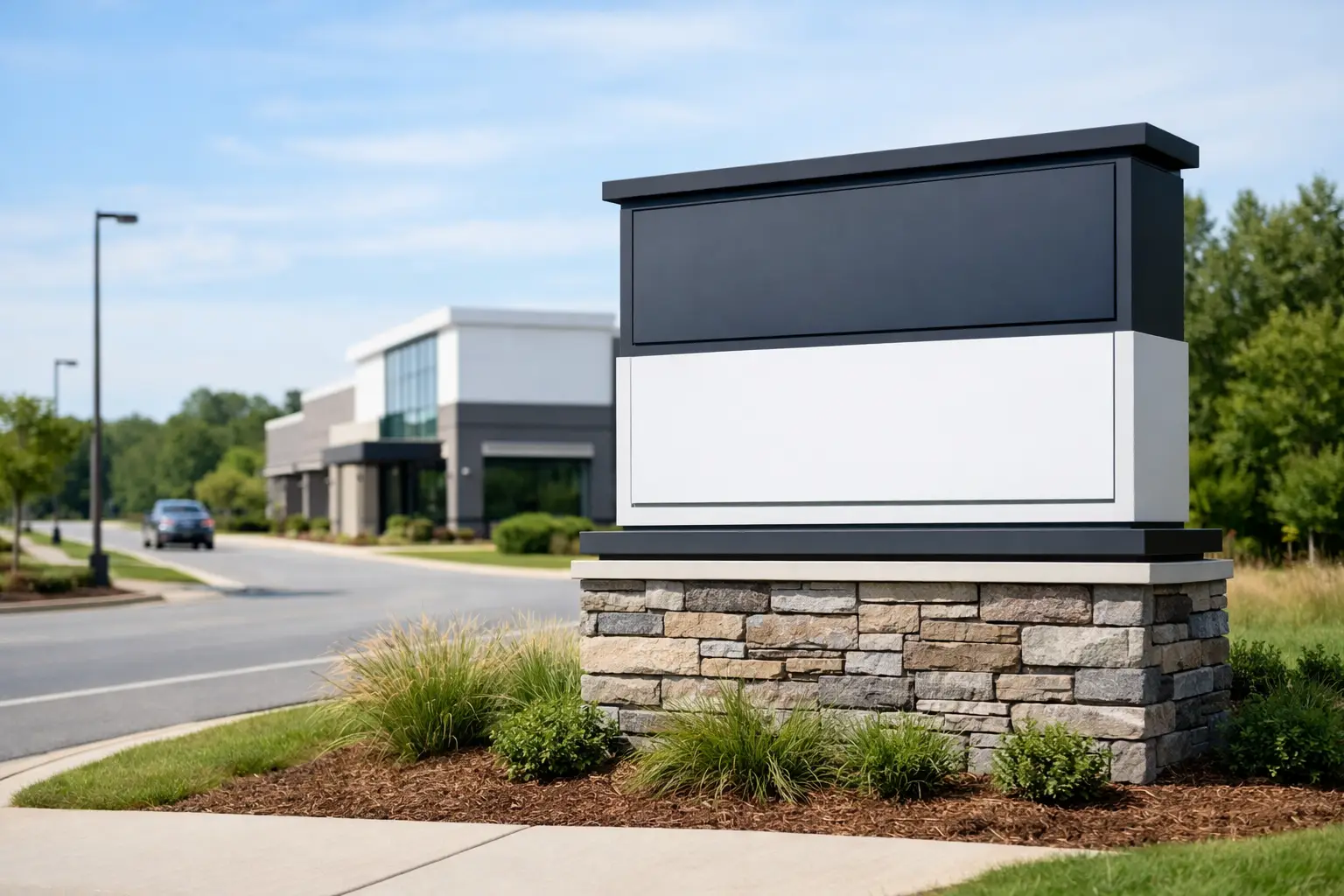
A business can have a great location and still get missed. That happens every day when visibility is weak, street presence is forgettable, or the sign looks like an afterthought. Monument signs for businesses solve that problem by giving your property a permanent, highly visible marker that tells people exactly where you are and what kind of brand they are about to walk into.
For retail centers, medical offices, schools, churches, multifamily properties, and professional buildings, a monument sign does more than label an address. It creates presence. It tells passing drivers, pedestrians, tenants, and first-time visitors that the business is established, organized, and worth noticing.
Why monument signs for businesses work
A monument sign sits low to the ground, usually near the street or entrance, and is built to feel like part of the property. That matters because it creates a stronger impression than a temporary panel or a small wall sign hidden behind landscaping. When done right, it becomes one of the hardest-working branding assets on the site.
The biggest advantage is visibility. If your business relies on passing traffic, easy wayfinding, or a professional exterior, a monument sign helps people spot you sooner and with less confusion. That can reduce missed turns, support walk-in traffic, and make the property feel easier to access.
The second advantage is credibility. A clean, well-built monument sign signals permanence. For doctor offices, dental practices, schools, office complexes, and local organizations, that visual cue matters. People often judge the quality of a business before they ever walk inside. If the exterior feels polished, the business feels more trustworthy.
The third advantage is brand control. A monument sign gives you room to use the right materials, colors, typography, lighting, and layout so the property looks intentional instead of pieced together over time.
Who benefits most from a monument sign
Not every location needs the same sign strategy, but monument signs tend to perform especially well for businesses set back from the road, properties with shared entrances, and organizations that want a more established look than a standard pole sign or storefront panel can provide.
Medical offices often use them because patients need clear, low-stress wayfinding. Property managers use them to identify apartment communities, office parks, and shopping centers while making the site feel more valuable. Schools and churches benefit from the visibility and sense of permanence. Restaurants, banks, and franchise locations use monument signs to stand out at busy intersections where a fast visual read can make the difference between being noticed and being passed.
If your location has vehicle traffic, landscaping at the front edge of the property, or a long approach from the road to the entrance, a monument sign is usually worth serious consideration.
The design choices that make or break performance
A monument sign should look good, but appearance alone is not the goal. The real job is to be noticed quickly and understood immediately. That means design decisions need to support visibility first.
Size and scale matter more than most owners expect
One of the most common mistakes is choosing a sign that is too small for the road, setback, or speed of traffic. A sign can be beautifully made and still underperform if drivers do not have enough time to read it. The right scale depends on distance, viewing angle, and surrounding visual clutter.
In a dense commercial area, a monument sign may need stronger contrast and simpler messaging because there is more competition nearby. On a quieter property, the design can lean more architectural and brand-driven without sacrificing readability.
Materials shape the message
Material choice changes how the brand is perceived. Masonry, stone, metal, acrylic, high-density foam, and aluminum each create a different impression. A medical campus may want a refined, professional look. A retail center may need durability and tenant flexibility. A school or church may want something warm, classic, and easy to maintain.
There is always a trade-off. Premium materials can create a stronger image, but they also increase budget and may add complexity during fabrication and installation. More economical materials can still look excellent when designed properly, but they need to match the setting and expected lifespan.
Lighting can extend value well beyond daytime
If your business operates in the early morning, evening, or winter hours, illumination becomes a major factor. Internal lighting, halo lighting, or external fixtures can make the sign visible after dark while reinforcing the overall aesthetic.
Not every property needs a lit monument sign. Some local zoning rules also affect what is allowed. But when nighttime visibility matters, lighting usually pays for itself in better readability and a stronger presence.
What businesses should include on the sign
This depends on the property type, but less is usually more. The strongest monument signs communicate the brand name clearly and avoid overcrowding.
For a single-tenant property, the business name and logo may be enough. For multi-tenant sites, the sign may need a panel system, changeable elements, or a directory-style layout. The more names you add, the more careful the hierarchy needs to be. If every tenant gets equal size and visual weight, the sign can become harder to scan from the street.
This is where strategic planning matters. The sign should not just fit information. It should prioritize what a visitor needs to recognize first.
Monument signs and local compliance
A monument sign is not just a design project. It is also a permitting, code, and installation project. Height limits, setback rules, illumination restrictions, and material requirements can all affect the final concept.
That is one reason many business owners prefer a full-service sign partner instead of trying to coordinate design, fabrication, and installation across separate vendors. A monument sign touches branding, engineering, site conditions, and local compliance at the same time. If one piece is missed, the timeline can slip fast.
In places like Queens, Brooklyn, Manhattan, the Bronx, and Long Island, site conditions also vary widely. A suburban-style property with a broad frontage has different opportunities than a tight urban site with limited clearance and heavier pedestrian traffic. The best solution is the one that fits both the brand and the real constraints of the property.
How to know if a monument sign is the right investment
If your building already has excellent frontage and highly visible signage at eye level, you may not need one. But if your site suffers from poor visibility, confusing access, weak curb appeal, or inconsistent branding, a monument sign can fix several problems at once.
Think about the cost in terms of daily exposure. Unlike temporary marketing, a well-built monument sign keeps working without requiring constant refreshes or campaign management. It helps people find you, remember you, and take your business more seriously.
That said, the cheapest option is rarely the smartest one. A monument sign is part of the property experience. If it looks undersized, dated, or poorly installed, it can weaken the brand just as easily as a strong sign can elevate it.
Choosing the right sign partner
This is where execution matters. A strong monument sign project starts with the right questions. What is the sign supposed to achieve? Who needs to see it? From where? At what speed? During what hours? How should it relate to the architecture and the rest of the site signage?
A dependable sign company should be able to guide the concept, recommend materials, account for visibility, manage fabrication, and handle installation without turning the process into a burden for the client. That is especially important for busy business owners and property managers who do not have time to chase multiple vendors or solve production issues themselves.
At 10X Sign Company, that full-project mindset is a big part of the value. The goal is not just to build a sign. It is to help businesses create a stronger first impression and get the job done right from concept through installation.
A monument sign should feel permanent because your brand should
The best monument signs do not scream for attention. They earn it. They make a property easier to find, a business easier to trust, and a brand easier to remember.
If your location needs stronger street presence, better wayfinding, or a more established look, a monument sign is not just another exterior element. It is often the first proof that your business takes itself seriously – and that is exactly what customers notice before anything else.