
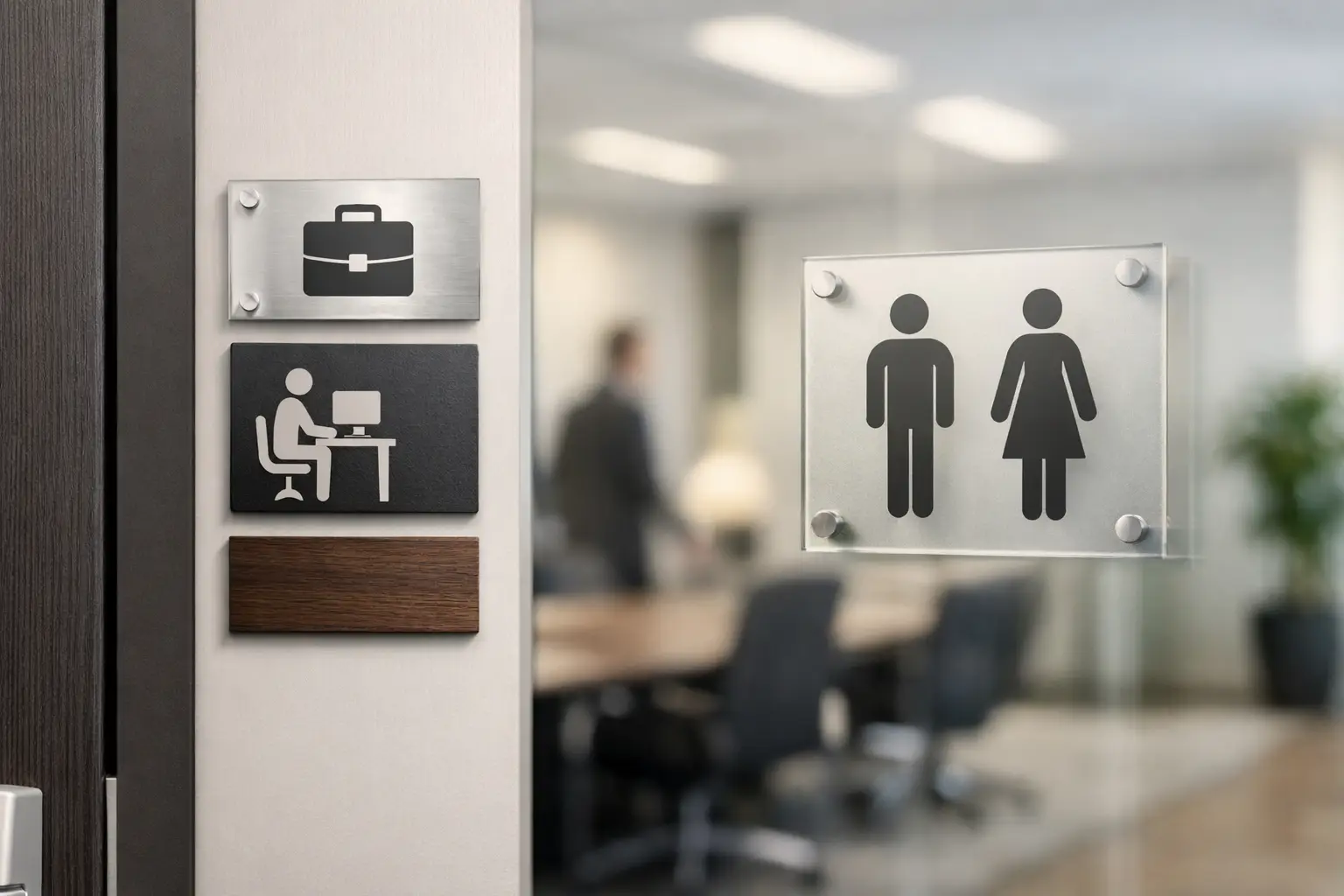
The wrong door sign creates friction before a customer ever steps inside. People hesitate, walk past your suite, tug the wrong handle, or assume your business is closed. Strong custom door signs for business fix that fast. They make your location easier to find, your brand easier to trust, and your space easier to navigate.
In a market like New York City, that matters more than most owners realize. A door sign is not just a label. It is part of your storefront, your customer experience, and your brand presentation. If it looks temporary, cluttered, faded, or off-brand, that impression carries into every interaction that follows.
Why custom door signs for business matter
A business door sign has a simple job on paper – tell people where they are and what to do next. In practice, it has to do much more. It needs to identify your business clearly, reinforce your professionalism, support compliance where needed, and hold up under daily use.
For a retail shop, that may mean hours, logo placement, and an entrance message that feels polished from the sidewalk. For a doctor office or dentist office, it may include privacy messaging, suite identification, ADA considerations, and directional information that reduces confusion for patients. For property managers, it may mean a coordinated system across multiple offices, common areas, and tenant suites. The right answer depends on the setting, traffic flow, and brand standard.
That is why generic plaques and quick-print stickers often fall short. They may solve one problem, but they usually create another. A cheap sign can peel, discolor, or look out of place within weeks. A custom sign is built to fit the environment, the brand, and the job.
What a strong business door sign should accomplish
The best door signs are clear first and attractive second. If people cannot understand the message at a glance, the design has failed. That does not mean your sign has to be plain. It means the design should support the message instead of competing with it.
A strong sign usually combines a few essentials: the business name, suite or room identification, operating hours if relevant, and any access instructions such as pull, push, employees only, private office, or appointment required. In some spaces, you may also need ADA-compliant room signs, safety notices, or branded privacy film integrated into the entry.
There is also a branding layer that smart owners should not ignore. Fonts, colors, finishes, and materials should match the rest of your visual identity. If your lobby sign, window graphics, and printed materials feel premium, your door sign should not feel like an afterthought. Consistency builds trust.
Materials for custom door signs for business
Material choice affects cost, durability, appearance, and maintenance. There is no single best option for every location.
Acrylic is a popular choice because it looks clean, modern, and professional. It works well in offices, medical spaces, salons, schools, and commercial interiors. It can be printed, frosted, layered, or mounted with hardware for a more finished look.
Aluminum is durable and dependable, especially where a more architectural or industrial finish makes sense. It performs well in both interior and exterior environments and is a smart pick for businesses that want longevity with a crisp appearance.
Vinyl lettering and decals can be effective for doors that need operating hours, logos, or temporary messaging. When designed and installed properly, vinyl can look sharp and cost less than rigid signage. The trade-off is that it may not deliver the same permanence or dimensional presence as fabricated signs.
Engraved plastic or ADA-compliant materials are often required in offices, schools, multifamily buildings, and medical settings. These signs are less about decoration and more about clarity, code requirements, and durability. They still need to look good, but function leads.
Glass doors add another layer to consider. Frosted vinyl, opaque lettering, and contrast-heavy graphics can improve visibility without making the entrance feel blocked off. For some businesses, especially in professional offices, that balance between openness and privacy is exactly what the space needs.
Choosing the right style for your space
Not every business needs the same type of sign, even when they share the same hallway. A boutique retailer and a law office have different traffic patterns, different expectations, and different branding goals.
For customer-facing storefronts, the door sign often works alongside window graphics and exterior signage. The goal is to support walk-in traffic and remove hesitation. Business hours, accepted payment logos, website or social references, and a strong logo mark can all play a role, but only if the layout stays clean.
For offices and suites, the focus is usually identification and professionalism. A brushed metal plaque, acrylic panel, or frosted glass graphic may be the right fit. These environments benefit from restrained design with strong readability.
For medical, educational, and multi-tenant properties, wayfinding and compliance become more important. In these settings, a door sign is part of a larger system. Room numbers, department names, ADA features, and directional consistency matter more than visual flair.
For restaurants, laundromats, churches, and service businesses, the mix often includes branding plus operating information. Customers want quick answers. Are you open? Which door is the entrance? Is pickup around the side? Can they walk in or do they need an appointment? A good sign answers those questions before anyone asks.
Common mistakes that cost businesses attention
The most common problem is trying to fit too much onto a small door. When every detail feels urgent, the message becomes harder to read. Keep the hierarchy tight. Your business name and primary instruction should be obvious from a distance.
Another mistake is poor contrast. Light gray text on glass may look subtle in a mockup, but it disappears in real conditions. Sun glare, reflections, and nighttime visibility change how a sign performs. Good design accounts for the actual environment, not just the screen proof.
Sizing is another issue. A sign can be beautifully produced and still fail if it is too small for the hallway, too high on the door, or blocked by hardware. Placement matters just as much as design.
Then there is the branding mismatch. A premium office with a flimsy sticker on the front door sends the wrong signal. So does a high-energy restaurant with a stiff, generic plaque. The sign should feel like it belongs to the business, not like a leftover fix.
Why full-service execution matters
Door signs look simple until you have to coordinate design, measurements, materials, production, and installation around an active business. That is where many projects slow down. One vendor designs it, another fabricates it, another installs it, and the result gets diluted along the way.
A full-service sign partner keeps the project moving and keeps the quality consistent. That matters when you are opening a new location, rebranding, updating tenant signage, or trying to tighten up a space without wasting time.
In a city where schedules are tight and access can be complicated, responsiveness matters just as much as craftsmanship. You want clear communication, accurate production, and installation that gets done right the first time. That is especially true for franchises, property managers, and growing businesses that need repeatable signage standards across multiple locations.
For many NYC businesses, that is where working with a company like 10X Sign Company makes the process easier. Instead of juggling pieces, you get one partner that can guide the concept, fabricate the sign, and install it professionally.
How to know when it is time to replace your door sign
If customers regularly miss your entrance, ask basic location questions, or seem unsure whether your business is open, your sign is not doing its job. If your hours changed and the door still shows outdated information, that is a problem too.
Visual wear is another clear signal. Peeling vinyl, faded colors, cracked panels, and outdated logos all chip away at credibility. Even if the decline feels minor to you, customers notice. They may not comment on it, but they absorb it.
Replacement also makes sense when the rest of your brand has improved. If you invested in a new lobby sign, updated graphics, remodeled the interior, or refined your logo, the entry should match. Businesses grow. Signs should keep up.
The best custom door signs are not flashy for the sake of it. They are clear, well-made, and built around how people actually move through your space. When the sign is right, customers feel more confident, staff answer fewer repetitive questions, and your business looks more established the moment someone reaches the door. If your current sign is doing less than that, it is probably time to fix it.